










Mananiya Vachnamrut
 Gadhada First Chapters: 6, 15, 16, 17, 18, 20, 22, 23, 27, 28, 31, 32, 33, 34, 35, 37, 38, 44, 50, 51, 54, 56, 58, 62, 63, 67, 72, 74, 76.
Sarangpur Chapters: 2, 3, 18
Kariyani Chapters: 2, 9
Loya Chapters: 1, 8, 17
Gadhada Middle Chapters: 2, 4, 7, 9, 12, 13, 15, 16, 24, 25, 26, 28, 33, 37, 40, 41, 45, 50, 53, 54, 59, 60, 61, 67
Vadtal Chapter: 16
Ahmedabad Chapters: 3, 7, 8
Jetalpur Chapters: 3
Gadhada Last Chapters: 1, 6, 7, 8, 9, 11, 13, 14, 17, 21, 22, 24, 25, 27, 32, 35, 37, 38, 39
Gadhada First Chapters: 6, 15, 16, 17, 18, 20, 22, 23, 27, 28, 31, 32, 33, 34, 35, 37, 38, 44, 50, 51, 54, 56, 58, 62, 63, 67, 72, 74, 76.
Sarangpur Chapters: 2, 3, 18
Kariyani Chapters: 2, 9
Loya Chapters: 1, 8, 17
Gadhada Middle Chapters: 2, 4, 7, 9, 12, 13, 15, 16, 24, 25, 26, 28, 33, 37, 40, 41, 45, 50, 53, 54, 59, 60, 61, 67
Vadtal Chapter: 16
Ahmedabad Chapters: 3, 7, 8
Jetalpur Chapters: 3
Gadhada Last Chapters: 1, 6, 7, 8, 9, 11, 13, 14, 17, 21, 22, 24, 25, 27, 32, 35, 37, 38, 39
Holy Vachanamrut(A prime Vachanamruts to easily learn by heart)
Gadhada First- 5
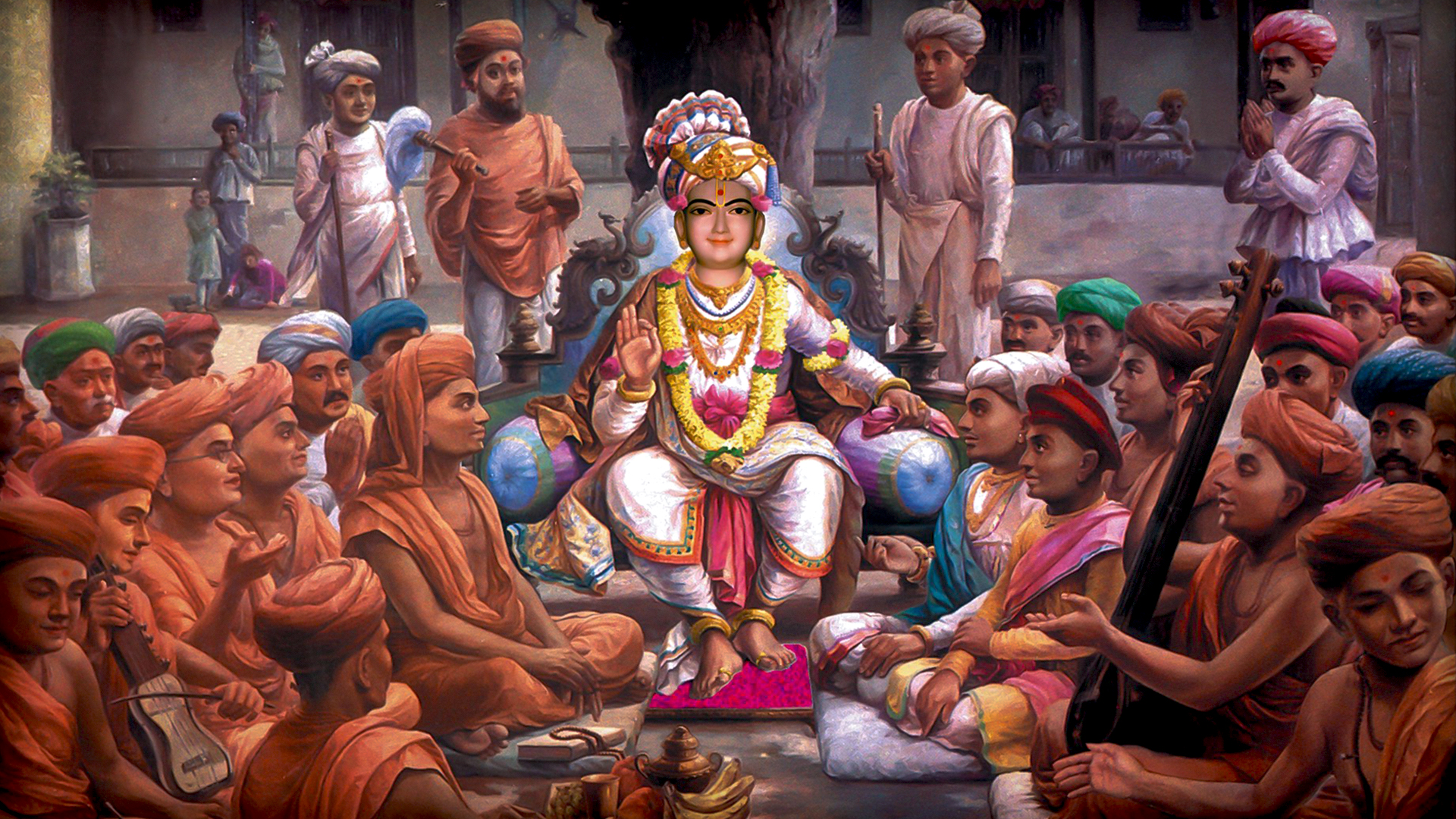
In Samvat 1876, Magshar Sud 8 (Thursday, 25 November, 1819, Shreeji Maharaj was sitting in Gadhada at Dada Khachar’s courtyard. He was completely dressed in white clothes. Before Him, an assembly of Paramahanasas and devotees from different regions were gathered. 1 Then Shreeji Maharaj said, (1) “One should mediate on God’s form along with his musktas. In doing so, if one cannot visualize the Murti within one’s heart, one should continue to mediate. However, one must never become disheartened and give up meditation. Devotees with such endurance earn the great grace of God, and God becomes bound by their devotion."(1)Iti Vachanamrutam||5||Gadhada First – 6
In Samvat 1876, Magshar sud 9, Shriji Maharaj was sitting in Gadhada at Dada Khachar’s courtyard. He was completely dressed in white clothes. Before Him, an assembly of munis and devotees from different regions were gathered. 1 Then Shriji Maharaj said, (1) “In this Satsang, the one who is discreet progressively recognizes the faults within himself and discovers the virtues of God and His devotees. Furthermore, for his welfare, if God and His sants say harsh words, he considers it in his own interest and does not get offended. This type of devotee continuously gains greatness in Satsang. (1) On the other hand, one, who is impudent experiences Satsang and its discourses, and continuously comprehends virtues within himself. Whenever God or his sants describes him his vices, he reacts adversely due to ego and instead comprehends vices in the adviser. This type of devotee continually declines and loses his status in Satsang. Therefore, one should abandon the honor of his virtues, should become valiant and should keep faith in God and His sants. Doing so, he is relieved of his impudence, and he attains greatness in Satsang.” (2)Iti Vachanamrutam ||6||Gadhada First – 9
In Samvat 1876, Magshar Sud 12, Shriji Maharaj was sitting in Gadhada at Dada Khachar’s courtyard. He was completely dressed in white clothes. Before Him, an assembly of munis and devotees from different regions were gathered. 1. Then Shreeji Maharaj said, (1) “Someone may have the faith that God is pratyaksh and perform His bhakti and darshan. In spite of this, he does not feel himself to be complete and has a feeling of inadequacy in his antah-karan, that until I have not seen the lustrous form of this very God in His divine abode, I have not achieved eternal salvation. One should not hear the discourses from a person with such ignorance. (1)To one who keeps firm faith towards the pratyaksh God, feels complete by the darshan of God and has no other desires, God forcibly shows His divine power and Murtis that reside in his divine abode. Therefore, one who has unique and unmatched faith of god should not wish for anything besides the pratyaksh God.” (2) Iti Vachanamrutam ||9||Gadhada First – 11
In Samvat 1876, Magshar Sud 14, Shriji Maharaj was sitting in Gadhada at Dada Khachar’s courtyard. He was completely dressed in white clothes. Before Him, an assembly of munis and devotees from different regions were gathered. Then Brahmanand Swami asked, (1) “Oh Maharaj What is the nature of vasana? Then Shriji Maharaj answered,”Vasana is the firm desire in one’s antahkaran for the vishays that have been experienced, seen or heard in the past. And the unfilled desires in one’s antah-karan for the vishays that have not been been experienced in the past is also considered to be vasana.” Then Muktanand Swami asked,(2)”Oh Maharaj! Who should be considered an ekantik bhakta of God?” Then Shriji Maharaj said “One who has no vasana other than God and performs the devotion of God regarding one’s self to be brahmrup is considered to be an ekantik bhakta.” (2)Iti Vachanamrutam ||11||Gadhada First -15
In Samvat 1876, Magshar Vad 3, Shriji Maharaj was sitting in Gadhada at Dada Khachar’s courtyard. He was dress entirely in white clothes. Before Him, an assembly of all sants and devotees from different regions were gathered. Then Shriji Maharaj narrated, (1) “He who has the devotion of God in his heart, has the inclination (vrutti) that, ‘I want to behave exactly according to any command given to me by God and sants.’ As such, he feels strength in his heart, and would never even mistakenly say that ‘I will only be able to follow these commands and won’t be able to follow the others.’ Moreover, he contemplates on the Murti of God and keeps courage in doing so. During contemplation, if he cannot visualize the Murti, he does not give up and keeps renewed patience. During contemplation, when evil thoughts arise and he is unable to abandon them, he understands the great glory of God, believes himself to be complete, and overcomes those thoughts. Furthermore, He continues to contemplate on the form of God in his heart. In doing so, even if it takes ten years, twenty years, twenty-five years, or even a hundred years he never gives up and never stops contemplating the form of God by being discouraged. Therefore one who keeps on contemplating in this way is called an of God.” (2) Iti Vachnamrutam ||15||Vachanamrut No. 6
Gadhada First - 16
In Samvat 1826, Magshar Vad 4 Shriji Maharaj was sitting in Dada Khachar’s courtyard. He was completely dressed in white clothes. Before Him, an assembly of sadhus and devotees from different regions were gathered. Then Shriji Maharaj stated, (1) “A devotee of God who has the ability to discriminate between truth and untruth, recognizes the vices in his self and eliminates them through his thoughts. If he perceives vices in sants or any devotees, then he eliminates those thoughts and only accept their virtues. He never perceives any vices in God. He believes each and every word of God and His sant to be the ultimate truth but does not doubt their words in any way. Thus, when sants says, ‘you are separate from the body, indriya, mind, and pran. You are eternal and the perceiver of all those, and that body and all related elements are temporary’, he takes it as the truth. As such, he behaves separate from all of it and behaves as a soul but does not surrender against the wishes of the mind. Moreover, he identifies and stays away from any object or kusang that would cause a deficiency in his ekantik dharma; but he does not get bound by them. Furthermore, he accepts positive thoughts and discards negative thoughts. He who acts in this way is to be considered wise because he has the skill of discrimination.”(1) Iti Vachnamrutam ||16||Vachanamrut No. 7
Gadhada First - 17
In Samvat 1876, Magshar Vad 5, Shriji Maharaj was conducting the narration of sacred scriptures in the west-facing hall, of Dada Khachar’s courtyard in Gadhada. He had adorned a white scarf and was wrapped in a white blanket. A white turban was tied on His head, and He had worn a garland of yellow flowers. A tassel made of yellow flowers had been inserted into His turban and He was in a very pleasant mood. At that time, Shriji Maharaj called Muktanand Swami, Gopalanand Swami, and other sadhus, and addressed them all. He said, (1) “Today I want to remove a little-wicked influence that remains in our Satsang. I want this issue to be disseminated among all the disciples, including paramhansas, sankhya-yogis, and karma-yogis. Now, what is this wicked influence in Satsang? The one who speaks without courage is the wicked influence in our Satsang. They say discouragingly, ‘Who is really able to observe the commands of God? Who is strictly able to observe the religious vows? So, we should observe as much as we are able. God is the redeemer of even the sinful and so, He will grant salvation.’ Furthermore, they utter, ‘to contemplate the Murti of God within our heart, is not in our hands. One can only contemplate God’s Murti if God showers His grace on him.’ By discouraging in such a way, they weaken others from their means of pleasing God such as dharma, gnyan, vairagya and bhakti. Therefore, from now, no one in our Satsang should discourage in such a manner. Always speak with courage. Whoever discourages in such manner should be considered to be impotent. A complete fast should be observed on the day when such discouraging words are uttered.”(1) Iti Vachnamrutam ||17||Vachanamrut No. 8
Gadhada First - 20
In Samvat 1876, Posh Sud 2, Shriji Maharaj was sitting on a throne made of cushion and pillows, outside the veranda of the east-facing room, at the courtyard of Dada Khachar in Gadhada. A white turban was tied on His head and tassels of yellow flowers were dangling from his turban. A garland of yellow flowers was around His neck. A corsage of white and yellow flowers was placed over His ears. A white duvet was covered around Him and He had adorned a scarf with black borders. Before Him, sermons from scriptures were being recited and an assembly of paramhansas and devotees from different regions had gathered. Addressing the assembly, Swamishri Sahajanandji Maharaj then said, (1) “Listen. I wish to ask you all a question.” With joined hands, all the devotees said, “Please ask.” Shriji Maharaj continued, “Among all the ignorant people who is the most ignorant?” Everyone contemplated over the question, but no one was able to answer it. Then, Shriji Maharaj said, “Well, I shall answer.” Everyone became glad and said, “Oh Maharaj! Only You will be able to answer it properly, so please elucidate.” Shriji Maharaj replied, “The soul that resides within the body, looks outwardly at attractiveness and unattractiveness, and also looks at infancy, youth and old age. As such, he looks at infinite other things. However, the observer does not look at oneself. With complete bahya-drashti, he continues to look at different objects. However, he does not look at oneself and thus he is the most ignorant amongst all the ignorant. Moreover just as he enjoys the visual experiences of innumerable forms through his eyes, he similarly, enjoys and experiences sensory pleasures through the indriyas such as the ears, skin, tongue, and nose. However, he does not enjoy the bliss of oneself and does not recognize his own form . Such a person is the most ignorant amongst all the ignorant, the most senseless amongst all the senseless, the most foolish amongst the fools, and the most wretched amongst all the wretched.” 2 At that time, Shuk Muni voiced a doubt, (2) “Is it in our own hands to look at our own form? If it is in our own hands then, why would the jiva remain in such sheer ignorance?” Shriji Maharaj replied, “For one who has satsang, it is within his own hands to see his own soul. Tell me, when has he tried to look at his own soul and has not been able to? When that same soul, becoming helpless under the influence of Maya, enters the state of dream (swapna) and deep sleep (sushupti), he does look inwardly (antardrashti). However, by his own wish, he never looks inwardly to see his own form. Conversely, he who thinks upon the greatness of God and looks inwardly can see his own form to be very bright and lustrous. In the middle of that light, he can see the pratyaksh Murti of Bhagwan Purushottam and becomes as blissful as anadimuktas. Therefore, whatever deficiencies that exist within a devotee is due to his own laziness.” (2) Iti Vachnamrutam ||20||Vachanamrut No. 9
Gadhada First - 22
In Samvat 1876, Posh Sud 4, at midday, Shriji Maharaj was sitting on a large and decorative cot in the veranda of the east-facing room, at the courtyard of Dada Khachar in Gadhada. He was completely dressed in white clothes. A tassel of flowers had been fit in His turban and a corsage of flowers had been placed over both ears. A garland of Guldawadi flowers was worn around His neck and He sat facing east. Before Him, an assembly of paramahansas and devotees from different regions had gathered and paramahansas were singing devotional songs. Then, Shriji Maharaj said, “Listen, I wish to say something.” All paramhansas stopped singing and became anxious to hear His sermon. Then Shriji Maharaj said, (1) “While singing devotional songs with musical instruments such as the mrudang, sarangi, saroda, tal, etc. if one does not remember God, then that singing is as good as not having sung at all. There are many people in the world who sing and play musical instruments without remembering God, but they do not attain mental peace through this. Therefore, when you sing devotional songs about God, recite His name, chant the name of Swaminarayan, and whatever else you do, it should be done while recalling God’s Murti. If one keeps his focus towards God during bhajan but does not retain that focus before starting other tasks, then his focus will not remain steady on God even during bhajan. Therefore, one should practice maintaining a mental focus on God, even while moving, walking, eating, drinking and performing all other activities. Only then does his focus towards God remain steady while performing bhajan. If his focus begins to stay steady towards God, it will also remain steady during other activities. However, a careless person’s focus will not even stay towards God during bhajan. Therefore, a devotee of God should become attentive and practice keeping his focus concentrated towards God’s Murti.” After telling this much, Shriji Maharaj said, “Now restart singing the devotional songs.” (1)Iti Vachnamrutam ||22||Vachanamrut No. 10
Gadhada First - 28
In Samvat 1876, Posh Sud 14, Shriji Maharaj was sitting on a large and decorative cot in the veranda of the room adjoining to the hall of Shri Vasudev-Narayan at the courtyard of Dada Khachar in Gadhada. He was completely dressed in white clothes. Before Him, rows of sadhus were arranged to dine. At that time, Shriji Maharaj said, (1) “When a follower is about to fall from Satsang, evil passions grow within him. At first, day by day, he begins to perceive vices in every other followers and feels in his heart that all followers are unwise, and only he is wise. As such, he considers himself to be superior to everyone else. Day and night, he experiences exasperation within himself. During the day he does not sit anywhere with ease, and during the night, he is unable to fall asleep. His fury never extinguishes, just as a smoldering half-burnt log. When one behaves in this manner, it should be understood that he is about to fall from Satsang. No matter how many days he stays in Satsang, he never experiences peace within his heart and ultimately, he falls. (1) Conversely, he who is about to flourish in the Satsang experiences growth of propitious passions within him. Day by day, he perceives the virtues of all followers within his heart. He understands all other devotees to be greater than him and considers himself to be inferior. Throughout the day and night, the overwhelming feelings of great happiness for the Satsang prevails within his heart. If these characteristics are found in a devotee, it is to understand propitious passions have increased within him. The more and more Satsang he does, the more and more satisfaction he experiences, and he attains the greatest status.” After preaching this much, Shriji Maharaj said, ‘Jai Sachidanand’, and returned to His room. (2) Iti Vachnamrutam ||28||Vachanamrut No. 11
Gadhada First - 49
In Samvat 1876, Maha Sud 14, at the time of dusk, Swamishri Sahajanandji Maharaj was sitting on a large decorative cot placed on a raised platform under the neem tree, in front of the temple of Shri Vasudev-Narayan at the courtyard of Dada Khachar in Gadhada. Two small diya were ignited in front of Him. He wore a garland of yellow flowers around His neck and wreaths of yellow flowers around both wrists. He was completely dressed in white clothes. Before Him, an assembly of munis and devotees from different regions had gathered. Then Shriji Maharaj said, “Let there be questions and answers.” Then Brahmanand Swami asked, (1) “While maintaining our focus on God, why is it that our focus only remains there forcibly while the focus effortlessly stays towards worldly objects?” Then Shriji Maharaj said, “The focus of God’s devotee does not remain anywhere other than with God. He is worried that he will find it difficult to keep his focus towards worldly objects. Therefore, for a devotee of God, it is very difficult to keep his focus on worldly objects, while a worldly person finds it very difficult to keep his focus towards God. Therefore, one whose focus is not towards God is not a devotee of God. However, if he associates with Satsang, gradually, through listening to the sermons of the sant, he will become a devotee of God.” Then, Brahmanand Swami again asked, (2) “By what means can one’s focus stay towards God in this manner (as mentioned in the first question)?” Shriji Maharaj replied, “The means to achieve this is to have introspection (antar-drashti). What is meant by introspection? Introspection means to look towards the Murti of the pratyaksh Bhagwan that one has attained. Even if instead of the Murti, the shat-chakra, or the abode of God is seen, it is not considered introspection. So, introspection consists of contemplating the Murti of God within oneself and fixating on it or by focusing on an external Murti of God. If one’s focus remains anywhere apart from the Murti of God, it is considered to be bahya-drashti.” Then, Shriji Maharaj addressed the paramhansas and said, “In pairs ask each other question and answers.” Then for a long time, the paramhansas asked each other questions and answers, while Shriji Maharaj listened and examined their intelligence. (2) Iti Vachnamrutam ||49||Vachanamrut No. 12
Gadhada First - 50
In Samvat 1876, Maha Vad 1, in the early morning, Shriji Maharaj was sitting in the front part of the veranda on the first floor of Dada Khachar’s courtyard in Gadhada. He was completely dressed in white clothes. Before Him, an assembly of munis and devotees from different regions was gathered. Addressing the munis, Shriji Maharaj asked, “One with an acute intellect attains Brahm. Does this intelligence refer to one who is competent in worldly matters, or not? Or does it refer to one who has a deep understanding of the Shastras and the Puranas, or not?”. The munis attempted to answer the question but it remained unanswered. Then, Shriji Maharaj answered, “Many are extremely wise in conducting worldly matter, yet they do not make any effort for their own salvation. Others are clever in understanding the Shastras, Puranas and the Itihas. Yet, they too make no efforts towards their own salvation. Thus, they should not be considered to possess an acute intellect. In fact, they should be considered to possess a dull intellect. Those who make an attempt for their own salvation may have little intelligence, but in fact their intellect is acute. Those who are attentively conducting worldly matters may have a acute intelligence, yet are in fact considered to possess a dull intellect. Upon this there is a verse:This verse means that in the context of worshipping God, the intellect of all worldly people is in the darkness similar to the night. In other terms, they do not worship God. Devotees of God are awake to the worship of God. In other terms, they remain continuously engrossed in the worship of God. The intellects of all embodied living beings remain awake towards experiencing the pleasures of the five senses, i.e. sound, touch, sight, taste, and smell. Thus, they remain engrossed in experiencing these sensual pleasures. The intellects of God’s devotees are in the dark in context of the pleasures of these senses. In other terms, they do not indulge in such sensual pleasures. Therefore, only those who stay attentive for the attainment of one’s salvation possess an acute intellect. Besides them, all others are fools.”(1) Iti Vachnamrutam ||50||
Vachanamrut No. 13
Gadhada First - 51
In Samvat 1876, Maha Vad 2, during the night, Swamishri Sahajanandji Maharaj was sitting on a large, decorated cot in the veranda of the west-facing rooms, in front of the temple of Shri Vasudev-Narayan at the courtyard of Dada Khachar in Gadhada. He was completely dressed in white trousers and a white tunic. A white turban was tied on His head. Before Him, an assembly of munis and devotees from different regions was gathered. Then, Shriji Maharaj said, “Let someone ask a question.” So, Purnanand Swami asked, (1) “The ten indriyas are of rajas attributes. The four antah-karans are of sattva attributes. Therefore, these indriyas and antah-karan are derived from Maya. However, How can God be seen through mundane indriyas, such as the eyes?” Then, Shriji Maharaj said, “Mundane objects are perceived through mundane mediums. Therefore, if God can be realized through such mundane indriyas and antah-karans, it implies that even God is mundane. Is that your question?” Then, Purnanand Swami and all the other munis said, “That is indeed our question. Oh, Maharaj! You have clarified it.” Shriji Maharaj said, “The answer to that question is as follows. The Earth covers a span of 50 koti yojans. On this Earth, there exists innumerable different objects. The Earth in its elementary form remains within all of these objects and also exists in a discrete form. Looking from the perspective of Earth, it appears that Earth exists in the forms of all these objects, and nothing exists except Earth. That Earth is produced from one particle of water. This water exists below, beside and above the Earth. Water even permeates throughout the Earth. Therefore looking from the perspective of water, there is no Earth; only water exists. This water was produced from one part of the light. When looking from the perspective of light, there is no water; only light exists. This light has been produced from one particle of air. From the perspective of air, there is no light; only air exists. This air has been produced from a small part of space. Therefore, if we look from the perspective of space, the four basic elements such as the air, and all that has been produced from them, such as the body and the universe, are not seen; only space is seen everywhere. Even space has been created from one part of the tamas-ahankar. The tamas-ahankar, rajas-ahankar, sattvik- ahankar, the elements, indriyas, antah-karans, and all deities are created from one part of Mahat-tattva. Therefore, if we look from the perspective of Mahat-tattva, these three types of ahankar, the elements, indriyas, antah-karans, and all deities do not exist, but only Mahat-tattva exists. This Mahat-tattva has been created from one part of Prakruti. Therefore, from the perspective of Prakruti, there is no Mahat-tattva; only Prakruti exists. At the time of desolation, Prakruti merges into one part of Purush and emerges out again from a part of Purush, at the time of creation. Therefore, from the perspective of Purush, there is no Prakruti; only Purush exists. There are infinitely many such Purushs who merge into, and then emerge from, one part of Akshar, which is the abode of Purushottam. Therefore, from the viewpoint of Akshar, none of them exists, only Akshar exists. Beyond Akshar, is Purushottam Bhagwan who is greater than Akshar. He is the creator, sustainer, and destroyer of all. He is the cause of all causes. That cause always pervades through whatever it creates, and simultaneously remains separate from its creation. Therefore, if we look from the perspective of the cause of all, Purushottam Bhagwan, besides the Purushottam Bhagwan, nothing exists. Such a God graciously bestows His pratyaksh darshan to all the human beings on the Earth, for the salvation of souls. At that time, when the soul associates with sant, he understands this greatness of the Purushottam Bhagwan and as a result, all his indriyas and antah-karans, becomes Purushottam-roop. Then it is through them, he can determine firm faith for this God. Just as a diamond can only be cut by another diamond, but not by anything else. In such a way, one can determine the firm faith through this God, and the darshan of God can only be done through God. It cannot be done through mundane indriyas and antah-karans.” After preaching this much, Shriji Maharaj said ‘Jai Sachidanand’ to all and returned to His residence. (1) Iti Vachnamrutam ||51||Vachanamrut No. 14
Gadhada First - 53
In Samvat 1876, Maha Vad 9, Shriji Maharaj was sitting on a large and decorative cot facing west, in the veranda of the west-facing room, in front of the temple of Shri Vasudev-Narayan at the courtyard of Dada Khachar in Gadhada. He was dressed in white trousers and a white tunic, and His waist was tied with an opulent saffron colored shelu with a gold and silver border. A turban of a saffron fabric was tied on His head. Tassels of flowers were dangling from His turban and garlands of flowers were worn around His neck. Before Him, an assembly of munis and devotees from different regions was gathered. Then Shriji Maharaj said, “Someone may ask me a question.” So, Muktanand Swami asked, (1) “Some in Satsang progress day by day, while other declines. What is the reason?” Then Shriji Maharaj answered, “The one who perceives vices in a great sadhu, declines, while the other who perceives only his virtues, progresses and his devotion to God also heightens. Therefore, one must never perceive vices in that sadhu and should only perceive his virtues. Vices should only be perceived when the sadhu breaks any one of the five vows that are set as the boundaries of the God’s regulations. If the sadhu does not break the vartmans but some aspects of his nature seems inappropriate and upon seeing these aspects, if someone ignores his numerous other virtues and concentrates only on his vices then, his own propitious virtues, such as gnyan and vairagya, decline. Therefore, if there is a break in vows only then should vices be perceived in a devotee of God but not for trivial reasons. If one does not perceive such vices then day by day his propitious virtues grow.”(1) Iti Vachnamrutam ||53||Vachanamrut No. 15
Gadhada First - 54
In Samvat 1876, Maha Vad 11, Swamishri Sahajanandji Maharaj was sitting on a large and decorative cot, on which a soft padded seat and cushion had been placed, in the veranda of the west-facing room in front of the temple of Shri Vasudev-Narayan at the courtyard of Dada Khachar in Gadhada. He was dressed in a white scarf. A saffron-colored cloth with tinseled borders was covered around Him. A blue tinseled silken turban was tied on His head. Before Him, an assembly of munis and devotees from different regions was gathered. Then, Muktanand Swami asked, (1) “Oh Maharaj! In the scriptures, it is said that someone who follows the Bhagwat dharma, walks with his eyes shut neither falls or collides. What is meant by this Bhagwat dharma?” Shriji Maharaj replied,Prasangam-ajaram pasham-atmanaha kavayo viduhu |
Sa eva sadhushu kruto moksha-dvaram-apavrutam ||
Vachanamrut No. 16
Gadhada First - 67
In Samvat 1876, Chaitra Sud 7, Swamishri Sahajanandji Maharaj was sitting at the lodging of the munis, at the courtyard of Dada Khachar in Gadhada. He was completely dressed in white garments. Before Him, an assembly of munis and devotees from different regions was gathered. Shriji Maharaj questioned the munis. (1) “There is an individual who has detachment towards worldly pleasures. However, he does have desires for the abode and the Murti of God. He also desires the same for one who keeps his company. He wishes, ‘The one who keeps my company should become detached from worldly pleasures and instead should develop affection for God.’ All his efforts are aimed at attaining the divine bliss of the God’s abode after leaving his body; but not for corporeal pleasures. What understanding is needed in an aspirant (someone who seeks salvation), so that the qualities of such an individual arises within him? That is the question.” Muktanand Swami answered, “One who is detached from the worldly pleasures is known as Satpurush. So, an aspirant should worship and perform devotion to a Satpurush as similar as God’s form and should understand that every word that he says is true and act accordingly. Then, the qualities of that Satpurush arise within him.” Then, Shriji Maharaj said, “That answer is correct, but listen as I explain the way of understanding by which an aspirant can attain the qualities of such a great Satpurush. One should recognize the virtues of an individual who has no affection for anything except for God in the following way: ‘This person is very great. Even though millions of people stand before Him with folded hands, He does not have the slightest affection towards worldly pleasures. Whereas, I am extremely insignificant as I am totally engaged in worldly pleasures. I do not understand anything in God’s talk at all, therefore I have loathing for myself.’ As he continues to repent in this manner. Moreover, he recognizes the virtues of a Motapurush and he accepts his own faults. While doing penitence in this manner, vairagya arises in his heart, and thereafter, he gains qualities similar to those of that Satpurush.” “Now, listen as I describe the characteristics of someone within whom the virtues of a Satpurush never arise. (2) Someone who believes, ‘This individual is said to be great, yet he has no sense of wisdom. He does not even know how to eat or drink. He does not even know how to dress. Even though God has given him many pleasures, he does not know how to enjoy them. When he gives to others, he does so without proper judgment.’ In this manner, innumerable faults are perceived in a Satpurush by someone who is malicious. Such a person never gains the virtues of a Satpurush.”(2)Iti Vachnamrutam ||67||Vachanamrut No. 17
Gadhada First - 76
In Samvat 1876, on the first Jeth Sud 11, Swamishri Sahajanandji Maharaj was sitting at His lodging, at the courtyard of Dada Khachar in Gadhada. Before Him, an assembly of several prominent sadhus had gathered. Addressing them all, Shriji Maharaj said, (1) “If a person full of anger, an envious person, a deceitful person or an egoist were a devotee of God, I do not get along with them. Also, anger and envy are the results of ego. I have no trust whatsoever in a lustful person, even if he is a devotee. If such a lustful person is in Satsang it is as if he is traitor. . (2)There is a devotee who has no flaws in following the five vows. No matter how much I try to put him in stress with my commands, and I make him let go of his preferences and make him follow my liking, yet throughout his life, then still, he never becomes perplexed. That is a true devotee. Without any effort, I naturally develop affection towards such a devotee. If a person does not have these virtues, even if I try, I cannot develop any affection for him. My nature is such that I can only have affection for someone who has this type of perfect devotion for God within his heart.” (3) Iti Vachnamrutam ||76||Vachanamrut No. 18
Sarangpur - 8
In Samvat 1877, Shravan Vad 12, Swamishri Sahajanandji Maharaj was sitting on large and decorative cot placed in the veranda of the north-facing room at the courtyard of Jiva Khachar in the village of Sarangpur. He was completely dressed in white clothes. Before Him, an assembly of munis and devotees from different regions was gathered. Then, Chaitanyanand Swami asked a question. (1) “Oh, Maharaj! What are the attributes of jealousy?” Shriji Maharaj replied, “If there is ego in one’s heartt, envy arises from that ego. Anger, jealosy and asuya also arise from ego. Attributes of jealousy is that when appreciation is shown for one who is greater than himself, he cannot stand it. If someone has such a nature, it should be understood that jealousy resides in his heart. A truly jealous person is incapable of tolerating anyones’ greatness.”(1) Iti Vachnamrutam ||8||Vachanamrut No. 19
Panchala - 5
In Samvat 1877, Fagan Vad 8, Shriji Maharaj was sitting on a large and decorated cot placed on a platform, at the courtyard of Zinabhai in the village of Panchala. He has dressed up a white scarf and a warm red coat made of pos. A white turban was tied on His head and a white blanket was covered around Him. Before Him, an assembly of paramahansas and devotees from different regions was gathered. Then, Swayamprakashanand Swami asked a question. (1) “In what situations is it appropriate for one to keep pride and when is it inappropriate? Under what circumstances is it appropriate to keep humbleness and when is it inappropriate? “Then Shriji Maharaj replied, “Before a traitor of Satsang or someone that defames the God and His great sant, it is only appropriate to keep pride. When such a person says defamatory words, he should be reprimanded immediately with words as sharp as a pointed arrow. One must not become humble before a dissenter for that is what is good. However, it is inappropriate to keep pride before God and the sant of God. Before them, one must get rid of all pride, become the servant of God’s servants, and behave humbly; for that is what is good.”(1) Iti Vachnamrutam ||5||Vachanamrut No. 20
Gadhada Middle - 7
In Samvat 1878, Shravan Sud 11, at night time, Swamishri Sahajanandji Maharaj was sitting in front of the temple of Shri Vasudev-Narayan at the courtyard of Dada Khachar in Gadhada. He was completely dressed in white clothes. Before Him, an assembly of paratmahansas and devotees from different regions were gathered. Muktanand Swami asked question to Shriji Maharaj. (1) “A devotee of God may have a persistence in his mind that he does not want to retain even a single nature within him that could obstruct his worship of God, but still, such inappropriate natures remain. What is the reason behind this?” Shriji Maharaj answered, “If a person’s vairagya is deficient, even if he has the zeal to eradicate the nature, it will not be discarded. It is like a poor man who wishes for very fine, delicious foods and nice, elegant clothes, but where can he get them from? If someone does not have vairagya, he may have a longing within his heart to attain the virtues of a sadhu, but it is very difficult for him to do so.” .”(1)Again Muktanand Swami asked, (2) “If one does not have vairagya, what means can be adopted to eradicate those vicious natures?” Shriji Maharaj replied, “If someone does not have vairagya, he must intensely serve a great sant, and remain obedient to the commands of the God. Then God mercifully looks on him and feels, ‘This poor man has a deficiency in his vairagya and is extremely harassed by lust, anger, etc. Therefore, let all his vicious natures cease.’ Subsequently, they are eradicated immediately. Alternately, by performing spiritual means for a long period of time, and with a great deal of effort, the nature may cease in his current birth, or in a future birth. Immediate eradication of vicious natures occurs only by the grace of God.”(2) Iti Vachnamrutam ||7||Vachanamrut No. 21
Gadhada Middle - 37
In Samvat 1880, Bhadarva Vad 1 (Sunday, 21 September, 1823), Swamishri Sahajanandji Maharaj was sitting in the veranda of the west-facing room, at the courtyard of Dada Khachar in Gadhada. He was completely dressed in white clothes. Before Him, an assembly of paramahansas and devotees from different regions were gathered. Then, Shriji Maharaj questioned. (1) “In the scripture, it is stated that even the learned scholars behave according to their inherent nature and the means of self-control that are specified within the scriptures are of no use. How can one discard such inherent natures?” All the munis thought about Shriji Maharaj’s question, but it was apparent that they would not be able to answer it. So, Shriji Maharaj said, “The answer to that question is as follows. In order to discard such tendencies, one must have complete faith in the words of the Satpurush who gives guidance about discarding it. The listener must have immense affection towards that Satpurush. If that Satpurush utters hurtful and harsh words, he must accept them to be be for his own benefit. Then an inherent tendency will be discarded. Other than this there is no way. Therefore, one who wishes to discard his inherent tendencies should not get distressed in any way, when the Bhagwan or a Satpurush insults him or utters harsh words in order to discard his inherent tendencies. He should have only gratitude for the adviser. If one acts in such a way than his inherent tendencies, which could otherwise never be discarded, are easily eliminated.” (1) ||Iti Vachnamrutam ||37||Vachanamrut No. 22
Gadhada Middle - 40
In Samvat 1880, Aso Vad 3 (Wednesday, 22 October, 1823), Shriji Maharaj was sitting at His lodging, at the courtyard of Dada Khachar in Gadhada. After bathing, and getting dressed in white clothes, He took His seat in order to perform His daily puja of the Lord. Then He prostrated in the northern direction, to Lord Shri Krishna. However, on that particular day, He performed one prostration more than usual. Noticing this, Shuk Muni asked, (1) “Oh Maharaj! Why did you perform an extra prostration today?” Then Shriji Maharaj replied, “Every day while bowing to Lord Shri Krishna, I used to pray, ‘Oh Maharaj! If any bodily feelings exist within me that the body, etc., are me, or that they are mine, eliminate all such beliefs.’ However, today, I had a thought that the kind of suffering faced by someone who harms a devotee of God, whether it is with his mind, words or body, either knowingly or unknowingly, does not occur as a consequence of any other sin. Therefore, in order to eliminate the sin of knowingly or unknowingly harming a devotee of God with the mind, words or body, I performed one extra prostration. (1)“Also, I have come to know that the damage that is faced by a soul and the misery that is inflicted on him as a consequence of harming a devotee of God is not inflicted as a result of any other sin.(2) Furthermore, the benefit gained and the kind of happiness experienced by a soul who serves a devotee of God with his mind, words, and body is not attained by any other means.“It is due to greed (lobh), ego (man), envy (irshya) and anger (krodh) that a person harms a devotee of God. These are the four reasons. Devotees of God that receive respect are honored because these four flaws are not present within him. Therefore, anyone who wants to become immensely blissful in his current life as well as after he has left his body, must not harm a devotee of God, either with his mind, words or body. If a person does somehow harm a devotee of God, one should verbally pray to him for forgiveness and with the mind and body, one should prostrate before him. Also, one should work to behave in such a way as to not harm the devotee of God again. However, one’s behavior should not involve atoning for a betrayal by prostrating after harming someone once, only to then harm him again and perform prostrations again. To ensure that this fact is remembered every day, all the sants and all the devotees should take a vow that when they perform their daily puja of God, they should perform prostrations according to their daily routine, and then, they should perform one extra prostration to apologize for harming the devotee of God during the day through the mind, words or body, knowingly or unknowingly. This is my command so all should abide by it.”(3) Iti Vachnamrutam ||40||Vachanamrut No. 23
Gadhada Middle - 41
In Samvat 1880, Kartik Vad 11 (Sunday, 28 November, 1823), Swamishri Sahajanandji Maharaj was sitting on a cot placed in the veranda of the west-facing room at the courtyard of Dada Khachar in Gadhada. He was completely dressed in white clothes. Garlands of yellow flowers were adorned around His neck and tassels (tora) of yellow flowers had been inserted into His turban (pagh). Before Him, an assembly of munis and devotees from different regions were gathered. Then out of His sheer mercy, Shriji Maharaj began to preach to His devotees, saying,(1) “He who wishes to worship God, should serve God and His devotees and should consider it to be a great fortune when he receives the opportunity to serve them. Moreover, one should serve them with devotion only to please God and for the attainment of salvation but not for the sake of praise. However, the nature of a soul is such that he only likes performing tasks that increase his ego but does not even likes to perform only the devotion of God in which his ego is not exaggerated. It is like a dog that finds a dry bone and takes it away to an isolated place and starts chewing it. The bone scraps his mouth and becomes covered in blood. Then he starts licking the bone and becomes pleased. The fool does not realize that he is enjoying the taste of the blood from his own mouth. Similarly, even a devotee of God cannot abandon the bone, in the form of ego. In all the spiritual activities he performs, he remains controlled by his ego. However, he does not, considering it to be the devotion of God, perform it for the sake of pleasing God. Even when he performs devotion to God, he does so to fuel his ego but does not perform them only to please God. There may only be very few devotees, such as Ratanji and Miyaji, who perform the devotion of God without any ego, and with the sole purpose of pleasing Him. Not everyone is able to forsake the taste of ego.” In reference to this, Muktanand Swami recited a couplet.Kanak tajyo kamini tajyo, tajyo dhatuko sang|
Tulsi laghu bhojan kari, jive manke rang||
Vachanamrut No. 24
Gadhada Middle - 49
In Samvat 1880, Fagan Sud 2 (Wednesday, 1 March, 1824), Swamishri Sahajanandji Maharaj was sitting on a large and decorative cot on which a soft padded seat and cushion had been placed in the veranda of the west-facing first floor in front of the temple of Vasudev-Narayan at the courtyard of Dada Khachar in Gadhada. He was completely dressed in white clothes, and a garland of white flowers was dangling from His turban (pagh). Before Him, an assembly of munis and devotees from different regions had gathered. Shriji Maharaj said, (1) “There is a great difference between the Murti of the pratyaksh Bhagwan and other mundane forms. However, he who is ignorant and is extremely foolish considers God and the mundane forms to be equivalent. This is because the observer of mundane forms and visualizers about those mundane forms has to stroll in hell and in the 8.4 million species for an infinite number of ages. (1)“The one who performs the darshan of God’s Murti and visualizes about God’s Murti, becomes free from the bondage of time (kal), deeds (karma) and maya, attains fearless (abhay) status and becomes the parshad of God. For that reason, my mind never becomes satiated by listening to the katha, kirtan, varta of Him or meditating on Him. You should all do the same.”(2) Iti Vachnamrutam ||49||Vachanamrut No. 25
Gadhada Middle - 53
In Samvat 1880, Vaishakh Sud 5 (Monday, 3 May, 1824), Swamishri Sahajanandji Maharaj was sitting on a soft padded seat and cushion, which had been placed at His lodging, at the courtyard of Dada Khachar in Gadhada. He was completely dressed in white clothes. Before Him, an assembly of munis and devotees from different regions were gathered. Then, Shriji Maharaj said, (1) “The attributes of infatuation (moh), which is stated in the scriptures, is that when such an infatuation pervades within one’s heart, that soul becomes unable to recognize his own vices. Therefore, not being able to identify one’s own vices is the attribute of infatuation. (1)“In addition, every soul has extreme vanity about his own wisdom. However, he does not even realize that he does not know anything about his own soul that resides within his body; is it dark or is it fair? Is it long or is it short? He does not know anything about this. Yet He perceives faults within Motapurush or in God. Such a person feels that ‘Although he is Motapurush, or He is God but some of his behavior is not appropriate.’ In this way, he perceives faults. However, the fool does not realise that God sees the souls and ishwars from the infinite cosmoses just as a person can see a drop of water held in his palm. Furthermore, He is the one who is the sustenance of infinite cosmoses, is the Bhagwan of muktas, and the one who creates and destroys infinite cosmoses. Even the major avatars are unable to completely grasp His true greatness and even infinite anadimuktas state that His glory is never-ending. Therefore, anyone who perceives faults in the acts of Bhagwan or the understanding of this Supreme Bhagwan should be recognized as being a traitor and being faithless. Such an individual should be considered to be the king of all fools. Whereas, God and the devotees have an understanding that is beyond this world. So how can a soul who believes himself to be the body understand them? A person’s own foolishness causes him to perceive faults in God and His devotees, and he thus becomes a traitor. Whereas, the Satpurush, a keen devotee of God, acts with the (divine) vision.” (2)Iti Vachnamrutam ||53||Vachanamrut No. 26
Gadhada Middle - 54
In Samvat 1880, Jeth Sud 7 (Thursday, 3 June, 1824), during the afternoon, Swamishri Sahajanandji Maharaj mounted a mare and rode from the courtyard of Dada Khachar in Gadhada to Laxmi-vadi. There, He rode on the mare for quite awhile before sitting on the raised platform at the middle of the farm. He was completely dressed in white clothes. A turban (pagh) made of a white dhoti with a black border was tied on His head. A garland of mogra (jasmine) flowers was adorned around His neck and a tassel was hanging from His turban. Before Him, an assembly of munis and devotees from different regions were gathered. Then, Shriji Maharaj asked a question to the munis. (1) “I am not as pleased by the eight-fold yoga (ashtang-yog), observance of the Sankhya philosophy, austerities (tap), renunciation (tyag), pilgrimages (tirth), observances (vrat), sacrificial ceremonies (yagna), and charity (dan) etc., as I am pleased by satsang. Therefore, amongst the other spiritual means, satsang is the greatest. What are the attributes of a person who considers satsang to be greater than all the other spiritual means?” Munis answered as per their understanding, but a perfect answer was not attained. So then Shriji Maharaj said, “Such a person has atmabuddhi with the sant of God. Consider a king who does not have any children, but then, has a son during his old age. That son may swear at him or pull his moustache and still, the king would never find any flaws in him. Even if he hits someone else’s son, or behaves mischievously in the village, the king would never perceive flaws in his son. The reason for this is that the king has atmabuddhi with his son. Similarly, only the man who has atmabuddhi with the devotees of God (Satpurush) has considered satsang to be more redemptive for the attainment of salvation than all the other spiritual means. ” (1) Iti Vachnamrutam ||54||Vachanamrut No. 27
Vartal - 9
In Samvat 1882, Posh Sud 8, Swamishri Sahajanandji Maharaj was sitting on a soft padded seat and cushion, which had been placed on a stage in front of the temple of Shri Laxmi-Narayan in Vadtal. He was completely dressed in white clothes. Before Him, an assembly of munis and devotees from different regions were gathered. Shriji Maharaj questioned the entire group of munis. (1) “Just as the three types of mundane pleasures, rajas, tamsas and sattva, are experienced during the three states of the body, how are the divine pleasures experienced?” The entire group of munis tried to answer the question, but a perfect answer was not attained. Then Shriji Maharaj said, “Suppose if the other four basic elements such as earth didn’t exist, and only space existed. And in this space there existed as many moons as there are stars in the sky. The intensity of that luster would be similar to the intensity of Chidakash. The Murti of God eternally resides at the middle of this Chidakash. When a devotee attains a samadhi state with that Murti, even if he experiences it for even a very short while, that devotee feels as if he has experienced the pleasures of the samadhi for thousands of years. The nirgun bliss of God’s Murti is experienced in this way. Even if he has imbibed in mundane pleasures for a long vast period, finally, it all seems transient. Therefore, the nirgun bliss in context with the Murti of God is eternal and immortal, while the mundane pleasures are mortal.”(1) Iti Vachnamrutam ||9||Vachanamrut No. 28
Vartal - 16
In Samvat 1882, Posh Vad 13, Swamishri Sahajanandji Maharaj was sitting on a stage, on which a soft padded seat and cushion had been placed under the neem tree at the courtyard of Shri Laxmi-Narayan in Vadtal. He was completely dressed in white clothes. Before Him, an assembly of munis and devotees from different regions were gathered. A scholar from Vadodara was sitting in the assembly. He said, (1) “Oh Maharaj! It would be most appropriate if You were to show a miracle to an eminent person.” Then, Shriji Maharaj replied, “I do not get along much with eminent people. The reason for this is that they have pride in their empire and wealth. Whereas, I have pride for My renunciation and devotion. There is no possibility that either will yield to each other. If I were to place an eminent person into the state of samadhi, he may give Me a village or a part of his land but I have no desire within My heart for such objects. This is because the village or land is meant to give happiness, but when I close My eyes and visualize God, the kind of bliss that I experience does not even exist in the empires of the fourteen loks. If there is as much happiness in empires as there is bliss by worshipping God, why would the great kings, such as Manu and Swayambhuv, leave their empires and go to the forests to perform austerities? If there is as much happiness in women as there is in worshipping God, why would King Chitraketu have left his ten million wives? Compared to the bliss of worshipping God, the pleasures of the fourteen loks are said to be like hell. Therefore, to one who has been become blissful with the bliss of God, the pleasures of the worldly sensations are as similar as hell. (1)“I also believe that only the bliss experienced by worshipping God is known to be bliss and all else is misery. Therefore, while worshipping God, if someone easily has drawn himself towards the Satsang, then I encourage him, but there is no such urge within My heart. The only urge that I have is of worshipping God and ensuring that the devotees of God preserve their satsang. What I have revealed to you is My deep-seated inner thought.”(2) Iti Vachnamrutam ||16||Vachanamrut No. 29
Vartal - 19
In Samvat 1882, Maha Sud 2, during the evening, Shriji Maharaj was sitting on a, soft padded seat and cushion, which had been placed in the roop-choki on the eastern side of the temple of Shri Laxmi-Narayan in Vadtal. He was completely dressed in white clothes. Before Him, an assembly of munis and devotees from different regions were gathered. On completion of sandhya-arti of the Lord, Shriji Maharaj said, (1) “Listen! I would like to talk about God. Whenever a soul incarnate in a human form on the land of Bharat-khand, the incarnation of God or the sadhu of God will also be present on Earth. If a soul discerns him then that individual becomes a devotee of God. Once he has become devotee of God it would be improper for him to have any kind of affection for anything, other than God, because compared to the bliss of God’s abode, the pleasures of the five senses(panch-vishays) is as good as hell (narak). Only insects of hell enjoy ultimate pleasure in the hell, but humans consider it to be extremely miserable. Similarly, the one who has discerned God becomes a parshad of God. Thereafter, ceasing to be the parshad of the God, he should not have a desire for the sensual pleasures of five senses, just as a insect of hell. Whatever a devotee of God wishes comes true. Therefore, that is his utter indiscretion, if he desires for anything except God in his ignorance. That is why, a devotee of God should consider the pleasures of the fourteen loks to be like the excreta of a crow. One should have intimate affection towards the devotees of God by thought, deeds, and words. He should also understand that even if perhaps a devotee of God has some desire lingering in his heart for anything except God, then still he will attain the status of Indra or Brahm-lok but unlike worldly souls, he will certainly not pass through the cycle of birth and death. Then how can one describe the glory and bliss enjoyed by a true devotee of God? Therefore, a devotee of God should always have deep affection only for God.”(1)Iti Vachnamrutam ||19||Vachanamrut No. 30
Vachanamrut No. 29
In Samvat 1884, Shravan Sud 6, Shriji Maharaj was sitting in the veranda of the east-facing room at the courtyard of Dada Khachar in Gadhada. He was completely dressed in white clothes and a garland of flowers was adorned around His neck. Before Him, an assembly of munis and devotees from different regions were gathered. Then, Shriji Maharaj said, (1) “In the scriptures, no other historical story is as surprising as of Bharatji. This is because although Bharatji was the son of Bhagwan Rishabhdev and to realize the God, he renounced his kingdom of the entire Earth. He went into the forest and while worshiping God there he developed affection for a fawn. Thus, the inclination (vrutti) of his mind took the form of that fawn. Even though he was so great, due to that sin, he had to reborn as a deer. Therefore, there are innumerable kinds of sins that exist but, it is an extremely grave sin for a devotee of God to have affection for anything other than God. Therefore, if a prudent person ponder over the story of Bharatji, an immense fear arises within his heart, ‘Lest I develop affection for anything other than God?’ He remains extremely fearful in this way. After giving up the body of a deer, Bharatji was again reborn in the family of a Brahmin, but due to his fear of devloping affection for anything other than God, he remained detached from all worldly affairs and intentionally behaved like a lunatic. He lived in such a way that he could keep his inclination constantly focused on God.” After Shriji Maharaj told this tale, since the arti of the Lord started, Shriji Maharaj went for arti. (1)Iti Vachnamrutam ||17||